
For many teams, the checkout still feels like a finish line. Conversion achieved, job done.
From an experimentation perspective, that thinking is outdated.
The customer journey doesn’t end at the checkout. In fact, that’s often where the real relationship begins. The point of sale is just one moment in a much longer experience between a business and its customers.
What happens after purchase- delivery, communication, unboxing, support, returning items, and loyalty- often determines whether someone becomes a repeat customer and brand advocate, or a quietly dissatisfied one-time buyer.
And dissatisfaction after checkout is particularly risky because it rarely shows up clearly in standard conversion metrics.
Conversion is a moment. Experience is a memory
Experimentation teams often spend most of their time optimising pre-checkout journeys, including the homepage, category pages, product listing pages, product details pages, navigation, pricing clarity, and calls to action.
But post-purchase experiences shape something arguably more valuable than conversion rate: memory.
Customers don’t remember how smooth checkout was if the sofa, for instance, arrives weeks late, costs more to deliver than expected, or is left on the doorstep. They don’t remember a beautifully designed product page if the unboxing feels underwhelming.
And they don’t feel loyalty toward brands that disappear the moment payment is taken.
Trust is fragile after checkout, and small frustrations can undo the goodwill built earlier in the journey.
Delivery is not an operational detail – it’s part of the product
Delivery is also where experimentation often drops off, not because it isn’t important, but because it rarely sits neatly within a single team.
Ownership is typically split across ecommerce, operations, third-party logistics, and customer service, making it harder to test, learn, and iterate in a joined-up way.
As a result, one of the most emotionally charged moments in the journey is frequently treated as an operational constraint rather than an experience to be designed.
Across multiple research programmes, delivery repeatedly emerges as a defining moment in the post-checkout experience.
Case Study – Oak Furniture Land
Research for Oak Furniture Land showed similar patterns in a different category.
Doorstep delivery was seen as inappropriate for a sofa, and delivery charges were actively resented. Customers struggled to understand the value or differences between delivery options.
Interestingly, shoppers were willing to pay more for the right sofa, but they became far more sensitive when it came to delivery costs. Faster delivery was appreciated, but rarely decisive. What mattered more was clarity and fairness.
When delivery costs or conditions felt unclear, hidden or misaligned with expectations, trust eroded quickly, even after the purchase had been made.
Case Study – Pizza Hut
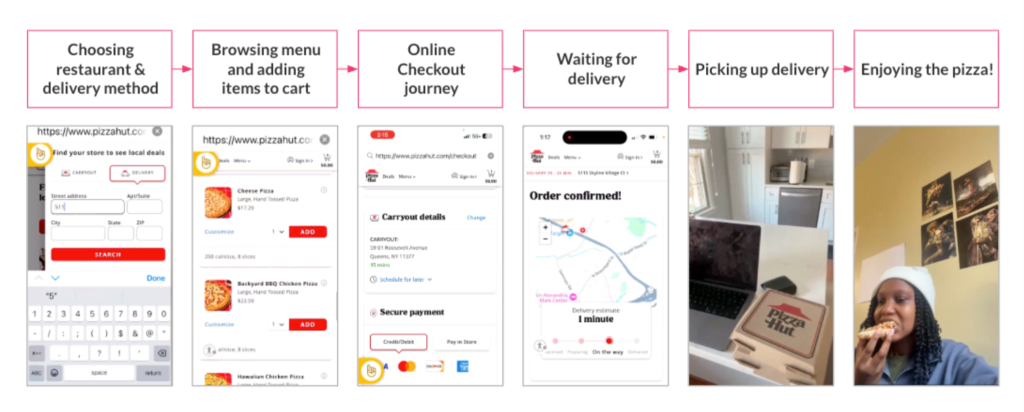
Our work with Pizza Hut is a good example of why stopping research at checkout limits insight.
During a problem-first experimentation workshop, we extended usability testing beyond payment to include the full real-world experience of delivery and consumption of the pizzas.
We recruited people who had never ordered from Pizza Hut before and gave them a budget to order exactly what they wanted from the website. But the sessions didn’t stop at checkout, as we stayed through delivery, unboxing, and eating.
If we had ended at payment, we would have identified issues in the ordering journey, but the strongest problems only became clear once the pizza arrived.
Participants’ overall perception of the brand was shaped far more by whether expectations matched delivery reality, how the handover felt, and how the food looked, tasted and held its temperature.
Those post-purchase moments led to some of the strongest experimentation hypotheses in the workshop. It was a clear indicator that conversion captures a transaction, but post-purchase moments shape brand memory and repeat intent.
Returns: where post-purchase pain becomes visible
Returns are often treated as a cost to manage, but the reality is more complicated, shaped by customer expectations, free delivery thresholds, the operational cost of handling returns and the challenge of getting stock back into inventory. Some brands have now ‘controversially’ started charging customers to return items.
More importantly, returns often highlight a gap between what customers expected and what they received.
Our work with YOOX Net-A-Porter Group focused on reducing return rates through a dedicated Experimentation Day and Hackathon.
We brought together the product, analytics, and research teams to understand why customers were returning items, particularly in clothing, where return rates were highest.
Instead of reviewing returns after the fact, return rate became something to improve through experimentation.
Teams worked on practical, testable ideas to improve size confidence, product information, and purchase behaviour, all areas contributing to higher returns.
The outcome wasn’t just a list of ideas. It was a shift in mindset: post-purchase performance became a part of the experimentation roadmap, not an afterthought.
When information comes too late, trust breaks
A luxury chocolatier brand offers a clear example of how delivery transparency (or lack of it) affects post-checkout sentiment.
Many customers only discovered the delivery costs at checkout, forcing some to restart their purchase after finding the total exceeded their budget.
The behaviour reflected this friction:
- Only 16% of mobile users scrolled to delivery information on product pages
- <1% opened the delivery information section
- 62% exited the basket before reaching checkout
- Delivery information links in the basket had some of the highest click rates on the page
Even when delivery itself was smooth and efficient, the experience didn’t always match expectations.
Packaging felt ordinary, branded elements were underplayed, and gift-friendly details weren’t communicated earlier in the journey.
In one case, signed-for delivery created unnecessary friction, leading to a disconnect between the premium in-store experience and the at-home reality.
Post-purchase is where personalisation should work hardest
One of the biggest missed opportunities we see is how little personalisation exists after the checkout.
Once payment is made, responsibility shifts between teams, and what had felt like a seamless journey can suddenly seem fragmented.
Customers notice that change, yet many brands fail to adapt their communication and support to reflect the customer’s needs at this stage.
Post-purchase personalisation isn’t just about recommending more products. It’s about being relevant and helpful at the right moment.
This includes:
- Session continuation: remembering intent and preferences beyond a single visit
- Implied and explicit defaults: delivery preferences, communication channels, timing
- Content prioritisation: surfacing what matters now, not what mattered pre-purchase
- Targeted content and offers: aligned to ownership, not acquisition
- Journey intervention and assistance: proactive support at moments of uncertainty
- Omnichannel continuity: ensuring in-store, app, and delivery experiences feel connected
Loyalty programmes also lose impact when the benefits are difficult to access. If rewards feel hidden or hard to use, they stop feeling like rewards.
Experimentation beyond checkout
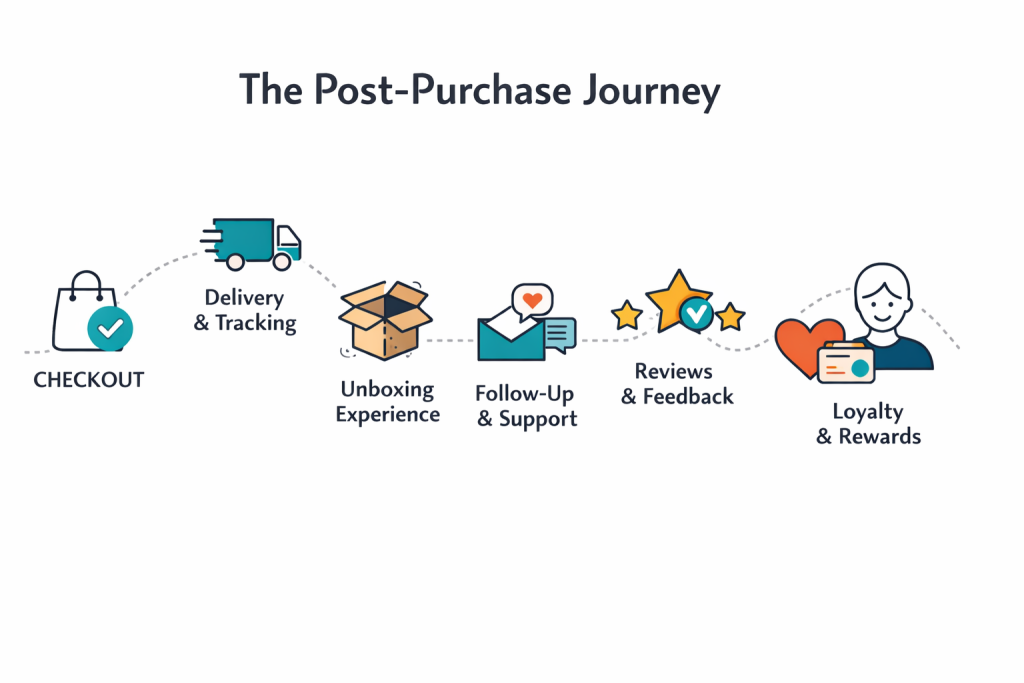
Post-checkout optimisation is where some of the most valuable learning happens, because it’s where brand promises are either fulfilled or broken.
Testing shouldn’t stop at conversion metrics. It should extend to:
- Delivery clarity
- Post-purchase communication
- Unboxing experience
- Returns
- Support journeys
- Loyalty discovery
For some businesses, this means tracking return rate, or for travel brands, it may mean the cancellation rate.
These areas are harder to measure, but they shape long-term behaviour far more than a marginal uplift in checkout completion ever could.
The journey continues
The question isn’t whether the journey continues after checkout; it always does.
The real question is whether that experience is intentional, tested and designed… or left to chance.
If you’re ready to look beyond conversion rates and understand what customers experience after they click ‘buy,’ we can help.
From delivery propositions to post-purchase journeys, we combine experimentation, customer insight and behavioural research to uncover where trust is being lost, where expectations aren’t being met, and where opportunities to strengthen loyalty exist.
Book a free discovery call with Creative CX, and let’s explore what your post-purchase checkout experience is really delivering and where it could be working harder for your customers and your business.