



There’s a familiar moment in many organisations.
Someone from the C-suite returns from a conference. They’re energised, inspired, and armed with slides full of possibility.
And then they say:
“We need to do personalisation.”
No context. No definition. Just a single word carrying enormous expectation.
Design teams imagine infinite variants. Engineering teams brace for complexity. Product teams wonder what just dropped off the roadmap. CX teams quietly worry about trust, privacy, and expectations.
The issue isn’t personalisation itself.
The problem is that it often starts without a shared understanding of the customer or the problem it’s meant to solve.
A Short History of Personalisation
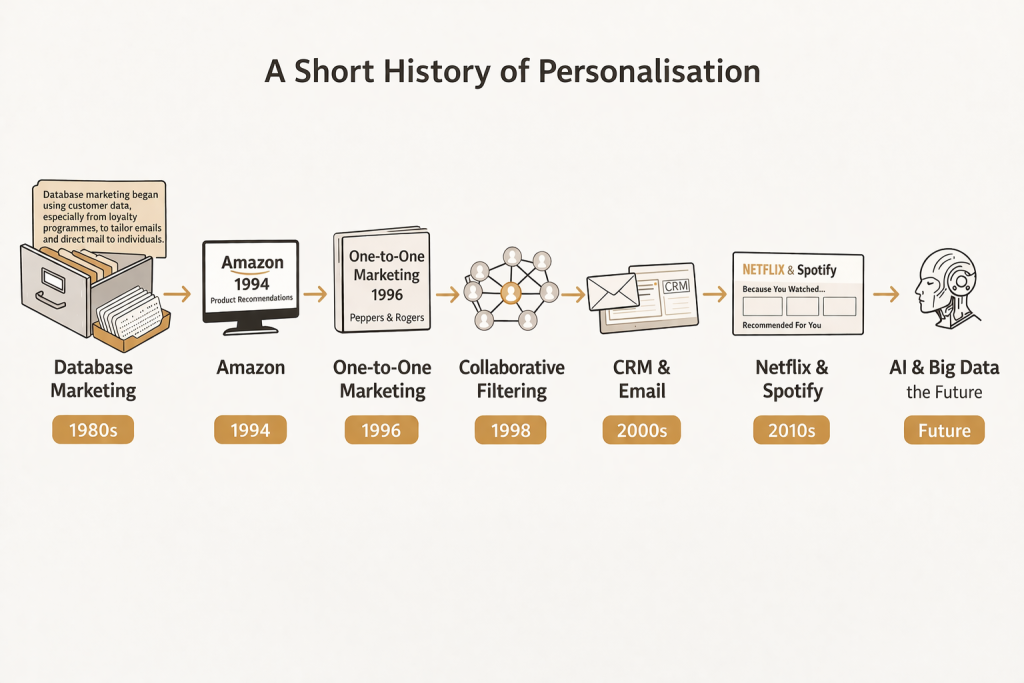
Personalisation is not new. It’s older than most teams realise.
In the 1980s, database marketing began using customer data, especially from loyalty programmes, to tailor emails and direct mail to individuals.
In 1994, Amazon began using behavioural signals to tailor product recommendations.
By 1998, collaborative filtering at scale was already shaping customer journeys in ways many brands still aspire to.
In 1996, Peppers and Rogers introduced One-to-One Marketing, reframing personalisation as an ongoing relationship rather than a campaign tactic.
Through the 2000s, personalisation became commonplace in CRM and email, relying on rules and segments to loosely reflect where customers were in a lifecycle.
By the 2010s, platforms like Netflix and Spotify showed that relevance in the moment could outperform demographic assumptions entirely.
Then came AI, automation, and unprecedented access to data.
Somewhere along the way, personalisation shifted from helping people to showcasing capability.
Where Teams Often Go Wrong
Personalisation is often treated as an initiative rather than an outcome.
Teams are asked to “do personalisation” before they’ve answered:
- Who is this for?
- What problem are we solving?
- Why should this experience be different?
Problem statements are assumed. Hypotheses are implied. Experimentation is replaced by implementation.
Instead of asking why an experience should adapt, teams move straight to how it might.
By 2026, the more mature teams have learned something important: personalisation does not stand alone. It only works when grounded in genuine differences in customer needs and motivations.
This is the same thinking behind our problem-first prioritisation approach.
Before ideas or features are explored, we focus on identifying and prioritising real customer problems through research and evidence.
We’ve written about that process in more detail in a separate article, where we share how starting with clear problem statements leads to better experimentation and stronger results.
You can read more about it here.
The Reality in 2026
Personalisation is rarely a feature. It’s the outcome of understanding customers, uncovering meaningful differences in needs, motivations, and designing around real problems.
It evolves as customer behaviour, expectations, and context change.
The most effective personalisation is rarely obvious. It shows up as experiences that feel clearer, calmer, and easier to use, journeys that respond appropriately without making users feel managed or over-targeted.
When it works, users simply feel understood.
At the same time, expectations have shifted. Generic journeys, irrelevant messaging, and repeated questions feel frustrating rather than neutral.
Trust is more important than ever: experiences that are transparent and respectful feel earned, while hidden tracking or over-confident assumptions erode confidence.
Discovering Personalisation Opportunities
The question is no longer how much we can personalise, but where it genuinely makes sense to.
We see personalisation as a natural extension of good CX, UX, and product practice, not a separate discipline.
Our approach to discovering personalisation opportunities is grounded in insight, feasibility, and impact, following the same principles we apply to all experimentation.
We start by identifying where experiences fail different users.
Conversations with customer-facing teams often reveal recurring frustrations, edge cases, or moments where a single experience is trying to serve competing needs.
Next, we review research and data to focus on the differences that truly matter: where audiences create value or risk, where journeys underperform for specific groups, and where a single experience cannot effectively serve everyone.
Not every variation needs personalisation.
Ground Ideas in Feasibility
There is little value in designing personalisation that cannot be delivered.
We assess what signals are available, how reliably audiences can be identified, and what is technically realistic to support. This keeps ideas grounded and avoids over-engineered solutions.
Understand Needs Across the Journey
Using methods such as Jobs To Be Done, we explore:
- What people are trying to achieve at different points
- How motivations shift over time
- Why the same experience may help one user but hinder another
Intent plays a role here, but always in service of understanding deeper needs and motivations.
Validate With Behavioural Evidence
Using tools such as HotJar, ContentSquare, FullStory, Quantum Metric, and VWO Insights, we analyse behaviour to identify:
- Where users hesitate or drop off
- Where journeys stall or loop
- Where small changes could deliver meaningful impact
Define and Prioritise Problem Statements
Only then do we define clear quantitative and qualitative problem statements that describe:
- The contrasting needs or motivations at play
- The cost of serving them the same experience
- The opportunity to improve the experience
These problem statements provide a clear foundation for prioritisation, experimentation, and delivery.
What Still Works and What Doesn’t
Despite the pace of change, fundamentals still matter: behaviour-led segmentation, personalised onboarding and re-entry, remembered preferences, and strong UX foundations.
AI enhances these principles, but does not replace them.
What no longer works includes one-size-fits-all journeys, heavy reliance on third-party cookies, over-engineered logic without clarity, or cleverness without purpose.
If personalisation does not clearly improve the experience for someone, it quickly loses value.
The Benefits of Our Approach to Personalisation
Our approach focuses on making experiences more relevant where it genuinely matters, grounded in real customer needs and disciplined discovery.
It ensures personalisation is problem-led rather than technology-led, focused on meaningful differences, and guided by evidence rather than assumptions.
Effort is prioritised where relevance will have real impact, and solutions are grounded in what can realistically be delivered.
The result is experiences that feel calm, helpful, and trustworthy rather than intrusive. Most importantly, personalisation is treated as a capability that evolves, not a one-off initiative.
The Opportunity Ahead
The most effective teams have stopped asking:
“How personalised can we make this?”
And started asking:
“Where would the user benefit from the experience being more relevant, and what problem can we solve for them?”
When personalisation is grounded in real customer needs, shaped by meaningful differences, and delivered with care, it stops being a buzzword and starts becoming what it was always meant to be: A better experience.
Where Creative CX Can Help
At Creative CX, we help organisations move beyond “doing personalisation” as an instruction and towards building it as a capability grounded in real customer understanding.
Our focus is on identifying meaningful differences, defining clear problem statements, and shaping experiences that suit your customers.
If you’re exploring how personalisation should mature within your organisation, or questioning where it can genuinely add value, we’d welcome the conversation.
Get in touch to explore how a more disciplined, experience-led approach can create relevance that feels natural.