



It felt fitting to be spending a day talking about climate action in the middle of a 38°C heatwave.
As temperatures soared across London, thousands of customers, policymakers, innovators, and industry leaders gathered for the Octopus Energy Tech Summit, the flagship event of London Climate Action Week.
It was difficult to ignore the irony. While conversations centred on the future of energy, technology, and climate resilience, the challenges being discussed were already playing out beyond the conference walls.
For us at Creative CX, the day wasn’t just about the future of energy. It was a reminder that customer-first innovation starts with understanding real problems, building trust, and using technology to create better outcomes for people.
Start with the customer, not the solution
One of the things that immediately stood out was the audience itself.
Too often, industry events become echo chambers, with businesses talking to other businesses about the future. Octopus Energy has taken a different approach, inviting thousands of its own customers into the room alongside policymakers, engineers, and tech leaders.
From Greg Jackson’s opening remarks onwards, there was a clear emphasis on solving real customer problems and ensuring innovation is grounded in the needs of the people it ultimately serves.
Throughout the day, there were plenty of exciting announcements, from new technologies and products to ambitious discussions about the future of the UK’s energy system. Running through all of them, however, was a consistent question: how does this make life better for customers?
Some of the most memorable moments came from hearing directly from Octopus customers themselves. Rather than abstract case studies or polished marketing messages, we heard real stories from people whose lives had been improved through products and services designed around genuine needs.
A short film showcasing how Octopus identifies and solves customer problems reinforced that philosophy. It wasn’t about innovation for innovation’s sake; it was about understanding where friction exists and building solutions that make a meaningful difference.
It’s an approach that resonates strongly with the way we work at Creative CX.
Whether we’re helping organisations improve digital experiences or build experimentation programmes, the strongest outcomes rarely begin with a solution looking for a problem. They begin with curiosity. They begin with understanding where customers are struggling, validating those assumptions with evidence, and then designing solutions around real needs rather than internal opinions.
When customer understanding informs decision-making, innovation becomes more relevant, more effective, and ultimately more valuable.
Trust is becoming a competitive advantage

One of the best sessions for us brought together Jimmy Wales and Hannah Fry for a conversation about trust, Wikipedia, and the future of artificial intelligence.
Hannah opened with a shocking statistic: Had Wikipedia chosen to monetise through banner advertising, it could have become a business worth around $10 billion.
So why choose a different path?
For Jimmy, the answer was straightforward in the fact that preserving Wikipedia’s neutrality mattered more than the money.
That same philosophy underpins the way Wikipedia has built trust over the past two decades.
Rather than presenting itself as flawless, Wikipedia openly exposes uncertainty. Articles clearly show where evidence is weak, where sources are disputed and where additional citations are needed. Its neutrality isn’t achieved through perfection, but through continuous change, review, and openness to correction.
It’s an interesting model for any organisation thinking about trust.
We have a great article on building customers’ trust and the peril of losing it: ‘Lidl Plus and the UX of Feeling Short-Changed’ if you want to read more on the topic.
Customers don’t necessarily expect perfection, but they do expect honesty. Being transparent about uncertainty, acknowledging mistakes and demonstrating a willingness to improve can build far more credibility than attempting to present certainty at all times.
AI should strengthen human judgement, not replace it
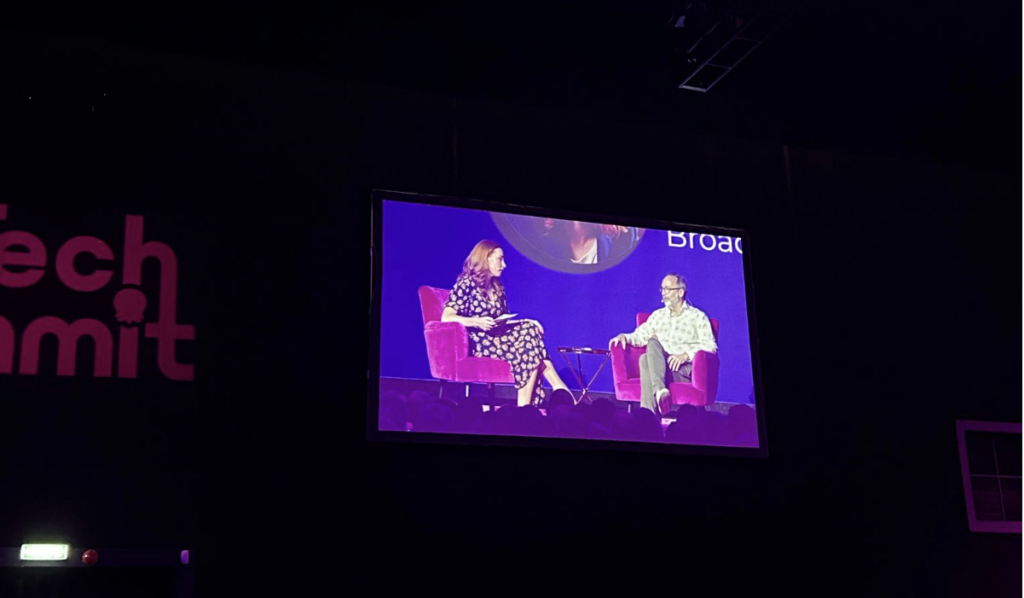
The conversation rarely stayed on one topic for long, but AI was a constant thread running through the day.
Discussions moved from the big-picture questions, with politicians and technology leaders debating whether AI can overcome its own sustainability challenges, to the practical realities of where it adds value in our everyday lives.
Jimmy Wales described one of the biggest challenges with generative AI as its ability to produce answers that sound entirely convincing while being completely wrong.
Hallucinations aren’t dangerous because they’re obviously incorrect; they’re dangerous because they’re plausible enough to be accepted without question.
His perspective definitely wasn’t anti-AI. In fact, he spoke positively about the role AI can play in supporting Wikipedia’s editors behind the scenes, helping people work more efficiently and manage information at scale.
Where he remains cautious is in allowing AI to replace human judgment in situations where trust, context, and accuracy matter most.
It was a perspective that connected neatly with many of the discussions taking place elsewhere throughout the day.
Whether the topic was energy infrastructure, customer experience, or AI, the strongest examples weren’t about replacing people with technology. They were about using technology to help people make better decisions.
Why the best innovation starts with the problem
Looking back, what made the summit so compelling wasn’t any single announcement or keynote. It was the consistency of the message running through every conversation.
The organisations making the greatest progress aren’t simply investing in new technology. They’re taking the time to understand their customers before deciding what to build, and they’re earning trust by being transparent about what they know, what they’re learning, and where they still need to improve.
Those are the same principles we see reinforced every day through our work at Creative CX.
Whether we’re helping organisations improve customer journeys or building experimentation programmes, the starting point is always the same: understand the problem before jumping to the solution.
Experimentation then provides the evidence to challenge assumptions and make better decisions with confidence.
Technology will continue to evolve, AI will continue to reshape industries, and customer expectations will continue to change. But the organisations that succeed won’t simply be those adopting the latest tools first. They’ll be the ones who stay curious and keep learning from their customers.
A huge thank you to everyone at Octopus Energy for hosting such a great and engaging event. We left with fresh perspectives and a renewed appreciation that meaningful innovation doesn’t start with technology.
It starts by understanding the problem, then testing your thinking until you’re confident you’ve found the right solution.
If you’d like to explore how a problem-first approach could work for your team, get in touch.